11 Jun 2026
ERA Forum focuses on ERA Act, talent attraction and ERA Policy Agenda implementation
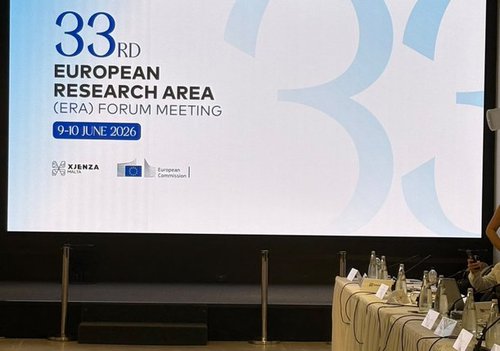
On 9 and 10 June 2026, the ERA Forum met for its 33rd meeting in Malta, upon the generous invitation of Xjenza Malta.
The meeting started with an update on the expected ERA Act. The proposal is currently expected to be presented at the end of October or the beginning of November 2026. This timing would also make it possible to use the 2026 R&I Days (tentatively scheduled for 10–11 November) to hold a broad discussion of the proposal with Member States and stakeholders before Council negotiations begin.
The Commission confirmed that the core of the ERA Act is intended to take the form of a regulation. As different elements of the ERA Act may require different legal bases, it is also possible that some parts will be proposed as a directive. Overall, the matter is still under examination.
The list of topics considered as candidates for inclusion in the ERA Act has not changed significantly since the end of the public consultation. These are structured into four chapters and include:
- Underinvestment in R&D: public and private, no hard targets foreseen but tools to encourage more investments;
- Alignment in strategic priorities and funding, including advancing the governance, possible role of ERAC;
- Barriers to the 5th freedom: Research Careers, Open Science, Research/technology Infrastructures, Knowledge Valorisation, and related issues;
- Safeguarding ERA Values: Freedom of Scientific research, equal opportunities, and related principles.
The next topic was an information point on the “Talent for Innovation Attraction Platform”. This platform is supposed to facilitate the implementation of the Commission recommendation on “attracting talent for innovation” (adopted on 26 January 2026) by bringing together experts from the fields of migration, employment, education, research and innovation. The aim is to make the EU more attractive to international students, researchers, highly qualified and skilled professionals, start-up founders and innovative entrepreneurs in key sectors for the EU’s competitiveness. This should be achieved by simpler and faster procedures for long-stay visa and residence permits through more digitalised processes; fewer documents and shorter processing times; easier transitions from study or research to work or entrepreneurship; improved intra-EU mobility; better access to information; and stronger cooperation between national authorities, universities and research organisations.
It was agreed to hold an ERA Forum Workshop on 24 September 2026 in Brussels, focussing on improving the implementation of the ERA Policy Agenda, addressing issues such as planning and communicating national implementation, involving stakeholders and practitioners, reducing duplication of work, etc.
The Forum discussed the timelines of the current and the next ERA policy cycles, taking up discussions from the last ERAC meeting about the fact that the ERAC work programme foresees for ERAC to initiate the preparation of the next ERA Policy Agenda (EPA) 18 months before the end of the current cycle. This point in time would be at the end of June 2026. As the current EPA was adopted 6 months later than originally foreseen and since many actions and policies started their implementation only towards the end of 2025 or even in 2026, it seems too early to start the preparations of the new EPA now. Furthermore, it seems appropriate to focus fully on the implementation of the current EPA. Another point is that the ERA Act will have a strong impact on the planning of the next EPA and will possibly even entail changes to the ERA governance. Considering all this, it was decided to inform ERAC about these considerations and to revisit the issue in January 2027, aiming at setting a new timeline.
Members of the Inspiring ERA team outlined the work carried out so far to support the implementation of the EPA. Further details are available on their website. ERA Forum members will submit suggestions for focus areas for the next phase of the project by the end of June.
Finally, four ERA actions and policies presented their progress and plans:
- Enhancing trust in science through citizen participation, engagement and science communication seeks to map the landscape in order to build on existing structures and initiatives. Its main deliverable is the establishment of a community of practice in the field of trust in science in Europe.
- Accelerating new approach methodologies has established a structure comprising a general assembly and four working groups (WG1: Development of NAMs and common European infrastructures; WG2: Validation/qualification, acceptance, and uptake of NAMs; WG3: Education and training; WG4: Openness & awareness) and is receiving considerable attention from participating countries, stakeholders, and experts.
- Developing a coherent framework for a European approach to integrity and ethics in R&I in the face of emerging challenges also aims to connect existing European networks and stakeholders in research ethics and integrity. In addition, it will facilitate dialogue, training activities, and mutual learning among research institutions, funders, policymakers, and professional communities, and develop practical guidance, operational tools, and standard operating procedures.
- Facilitating and accelerating the responsible use of AI in science intends, inter alia, to provide annual updates to and dissemination of the ERA Living Guidelines on the use of generative AI in research, as well as a joint roadmap on AI in Science and an agreed strategic funding agenda with Member States and European funders.